Not quite sure if the terminology is correct, but for me it’s more of a “fluid looseness” in the forearm rather than a deliberate adjustment of the wrist that keeps up strums smooth. Having the pick “sit right” also takes a lot of the need for deliberate thought out of my strumming as well so my attention can stay on rhythm.
Maybe your grip on the pick is too tight, wrong angle or the pick is too heavy at this stage?
Hello @Browneagle426 and welcome to JustinGuitar and the Community.
I have presented a few live club sessions on rhythm and in them discussed the importance of a relaxed arm, wrist, hand, fingers. Try watching my most recent rhythm and strumming club session here.
Hi, I’m trying to strum old faithful to Ed Sheeran’s Sing on the app. The song has 4 Am chords than 4 Em chords and that repeats for most of the song. I can’t seem to wrap my head around how to strum old faithful to this. There are 5 strums in old faithful, right? D, D, U, U, D. Is old faithful supposed to be for songs with 4 chords in a bar only? Or is it supposed to be played like this?
Hi @elseworldkc, welcome to the forum! This song has 4 bars of Am followed by 4 bars of Em. Each bar has 4 beats. When strumming, you go down on the beat, and up in the space between the beats, so for each bar, your arm goes 4 times down and up.
If you only strum on beat 1 of the bar, you will end up strumming 4 x Am, 4 Em, etc.
When you add a more complicated strumming pattern, like old faithful, you will still be moving your arm down and up 4 times in each bar, but you will strum the strings more than once, indeed 5 times for old faithful. It would look like this (each line is 1 bar; D and U are the ups and downs where you actually strum the strings, _ is when you move your arm but don’t strum the strings):
Am
D _ D U _ U D _
Am
D _ D U _ U D _
Am
D _ D U _ U D _
Am
D _ D U _ U D _
Em
D _ D U _ U D _
Em
D _ D U _ U D _
Em
D _ D U _ U D _
Em
D _ D U _ U D _
etc
Thank you @LadyOfTheCastle and @EdmundD! Very helpful. This leads me to a more basic question though. If I wasn’t using old faithful, and just keeping this song simple, am I supposed to be strumming 4 times per bar, like so?
Am
D_D_D_D_
Am
D_D_D_D_
Am
D_D_D_D_
Am
D_D_D_D_
Em
D_D_D_D_
Em
D_D_D_D_
Em
D_D_D_D__
Em
D_D_D_D_
etc
I think I just realized I’ve been playing this song (and others on the app) all wrong? I’ve been only strumming once on beat 1 and moving my arm silently for the + 2+ 3+ 4+. I’m feeling rather silly at the moment but grateful nonetheless!
When starting to learn a new song, start with just 1 strum per bar, like you have been doing. Once that goes well, try strumming on 1 and 3, so D _ _ _ D _ _ _ . Once that goes well, try strumming on all 4 beats, so D_D_D_D_. After that, you can try a more complicated strumming pattern. So yes, it’s perfectly fine to try D_D_D_D_ for this song.
I reviewed this but I am analytical. I understand 4/4 time or 8 strums and 16 strums as they are all divisible by 4. But:
D D UU D is five strums and not divisible by 4. Justin doesn’t mention why of if there is a reason to be skipping a strum. Can you dumb it down for me? Thanks
There are 4 beats in the bar, not necessarily 4 strums. There are many different strumming patterns with any number of strums. Your hand will move down 4 times and up 4 times, sometimes you will strum and sometimes you will miss. It doesn’t have to be a multiple of 4 strums. There are many more lessons on strumming as you work through grade 1, it will make sense eventually.
You can play 4:4 with one strum per beat. These are usually down strums. Counted 1 - 2 - 3 - 4
D - D - D - D
(Sorry they don’t line up exactly, but hopefully you see the correlation.)
You can play two strums per beat, or eighths. You can play these all down, or alternating down-up. Regardless, you’d count them
1 - & - 2 - & - 3 - & - 4 - &
Now, if you’re playing downs on the 1,2,3,4 and ups on the &s you get
1 & 2 & 3 & 4 &
D U D U D U D U
But, sometimes you “miss” the strings, that is, you move your hand but don’t strum them.
Now, where / indicates “miss the strings”, for the case above you get:
1 & 2 & 3 & 4 &
D / D U / U D /
Hope that helps!
Edited to add: you might want to review this lesson, where I think Justin introduces this concept better than I explained it!
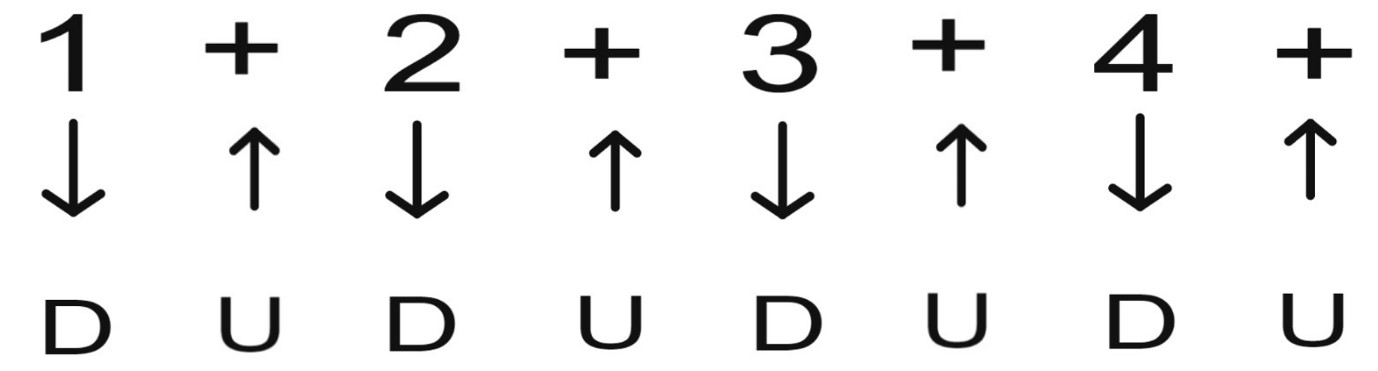
This represents the space of one bar of 4/4 music.
Each and every numbered count is a ‘beat’. There are four beats - these are named quarters. They have a D and a downwards pointing arrow below that indicates you make a down motion on the beats.
Also, there are four + symbols accompanied by U and upwards pointing arrows below. These match with the motion of moving your hand back up after a down.
If only the numbered counts of 1, 2, 3 & 4 were shown you would think of this as four beats, four quarters, four down strums.
The inclusion of the + symbols between shows that each beat has been subdivided, each split in two equal parts. This means we would describe the entirety of this bar as eighths.
So far, the suggestion is that this diagram indicates that you move your arm down four times, up four times, and ‘hit’ the strings each and every time. Let’s run with that idea.
Then what if one or more of the markings were removed? Time would continue and the duration of the bar of music would continue with it. Those blank spaces could be taken as moments when your hand is moving but you do not ‘hit’ the strings. It is a ‘miss’.
For example:
Two blank spaces, the + after 1 and the + after 4. You move your hand down four times and up four times. You actually strum according to this sequence:
Three blank spaces, the 2, the + after 3 and the + after 4. You move your hand down four times and up four times. You actually strum according to this sequence: