I’m having trouble with keeping my hand moving during strumming. Can anybody help me?
I don’t know if you’re trying to strum in time to a song but my approach when I was learning fundamentals such of strumming was to focus on one thing at a time. For example, if you’re trying to strum in time to a song and maybe do chord changes as well, then you’ve got three things going on at once. You need to have each thing nailed down in isolation first in my experience.
So if it’s a pattern like Justin’s old faithful, I’d practice the pattern in isolation, playing at whatever speed you need to play at to make it happen. I used to say out loud the pattern, e.g. down, miss, down, up, miss, up, down, up until I had it. It involved starting painfully slowly. Don’t worry about metronomes or anything else to begin with, because then you’re trying to do two things at once. I typically did it with muted strings too
3 Likes
Hi Hans, are you following the Strumming SOS course? Practicing strumming slowly with a metronome is the best advice I can give…it takes sometimes to develop the feeling in your forearm and hand, but once it’s established it will go on autopilot.
1 Like
I see we’ve given conflicting advice… I think I’d say that the metronome is stage 2 - once you can play the pattern without a metronome, then try introducing the metronome - it depends how much they are struggling really 
2 Likes
It would be easier for me to tap my foot if I have the metronome click guiding me, but yes definetely you need to do it on muted strings as Matthew suggests.
I’ve been struggling for such a long time with strumming patterns and the metronome was what helped things fall into place for me…but really we’re all different.
3 Likes
Some additional info on your current ability would be useful … whether you are strumming in a framework of 8ths with downs and ups, whether you are following specific patterns within specific songs or asking for general advice etc.
2 Likes
Honestly, I find that the recommendation to always keep the hand moving at a regular 1/8th note tempo is too restrictive. For some songs I do that (definitely when I’m using “old faithful”, I do). But for others, I don’t, and I find that attempting to do so messes up the “feel” of the song.
None of my in-person instructors ever made this point, either.
I’ve paid attention to guitarists playing live and it seems like many of them treat it like this, too.
Maybe it’s that “Level 1” strumming is always keeping that regular hand movement but “Level 2” strumming and above involves exceptions? And I just didn’t spend much time doing “Level 1” strumming?
1 Like
You may find they are but some of the movements are very small. I tend to keep a constant rhythm but very often it’s very difficult to see it - I can feel it though.
2 Likes
Have you tried Justin’s free Strumming Machine? You can strum along either with his suggested patterns or create your own with a chord and a speed of your choice. I found it quite useful in the beginning.
4 Likes
oh I’ve looked hard for that and they don’t always do it. it’s especially obvious if there are picked notes in there or palm mutes but I’ve seen plenty whose strumming hand follows through a longer downstroke when they’re holding a longer note (such as when they stop strumming for awhile to sing and they just let that last chord ring or they mute with their fretting hand).
I think what it comes down to is that they aren’t relying on that strumming hand to keep time. they’re doing it some other way. maybe they’re using a drummer (if they have one) or they’re being looser with their timing. I’ve encountered plenty of times in recordings where the timing is a bit loose. sounds great if you can find that “groove” the band is in, but if you’re trying to play along and follow a more robotic tempo, it sounds like a whole mess.
this is why I said I think it’s just a progression in skill.
1 Like
Sure, no one will do it all the time, I’m talking about a strumming pattern here, not stopping to play individual notes or a splang across beats.
You’ll always find exceptions - take a look at Ronnie Wood 
1 Like
that’s the thing, though. even if they are more or less using a strumming pattern, some folks don’t always move their hand when they aren’t hitting the strings. I was just citing some of the more obvious examples.
some people are more prone to doing that than others.
1 Like
This helps. Thank you!
1 Like
There may be exceptions but in a song where it’s all strumming I believe it’s the right thing to do… if you keep your hand moving then keeping time comes pretty much automatically
1 Like
We are not all the same and I guess some find keeping the strumming arm moving to be helpful. Others not.
Certainly for me, following Justin’s advice to keep the strumming arm moving has been the root and key to my strumming development because you can do it in a simple strumming pattern and as long as you have the arm moving in rhythm you can then very easily switch to a different or more complex stumming pattern without any change in the rhythm. Lots of good examples in the song lessons, free fallin being a good example.
It definitely helped me and it’s not robotic if you are into the music then the strums come naturally and sounds natural. Just look at Justin’s strumming. He always keeps the hand moving in rhythm but it also sounds so smooth and flowing. Not robotic at all.
Going back to the original post. I did what Matt says and first got the pattern, keeping the arm moving slowly, doing muted strumming, then like Silvia says, the same but with metronome, then with chords. Then speed it up.
3 Likes
There’s been some discussion above about whether it’s strictly necessary to keep the hand moving at all times. I would say, you definitely should be able to do it.
If so, and you decide to abandon it and can keep good time anyway, sure go for it. However, if you’re having trouble doing it, that indicates that your strumming motion is not automatic and independent of other stuff going on. So, keep that hand moving.
As an exercise, you could just listen to a medium tempo song with your guitar in hand. Mute all the strings and just strum along, keeping the hand moving all the time. You could do this while executing simple strum patterns, say down on beats 1 and 3 or down on beats 1 and 4. Keep the hand moving for all the beats. Then gradually increase the complexity of the pattern, incorporating up strokes (like old faithful). Good luck!
5 Likes
It could be due to trying to fix too many things at once, while some practice should evolve around doing one thing right as and combining them together in some other practice.
- Practice without focusing on a song. practice some chord progressions of 3 or four chords and focus on keeping a steady rhythm and doing the right changes.
- Use a drum track and/or a metronome (both in separate exercises) and make sure you can strum along.
- Can you still strum along making the changes for several exercises? (several different progressions)
- can you apply some dynamics while maintaining a pace? (softer, louder, with accents on the beat or not etc)
- can you slow down and speed up while keeping a good strum flow going?
- can you count out loud on beats when strumming?
- can you name the chord out loud when strumming?
last but the most solid check/advice;
learn to strum and do chord change whithout looking at the fretboard.
practicing just that, respecting timing etc, will improve your strumming stability. You can train this doing changes between chords on a beat. Result: you free up more processing time in your brain to be focussing on other stuff.
More on that in the recording of my recent Live Club about learning to play AND sing:
That is true, if you developed a firm inner clock. If you have a good rhytmic flow for the song you can safely stray from the continuous motion because the vibe of your version the song requires it.
As long as you you put the bar high for yourself when checking it all works out (= recording, checking the timing, trying it along a drum beat and/or metronome etc). More advanced players will feel when this is off, beginners (or people convinced they have good rhythm but actually don’t) tend to wander off pace.
1 Like
Hans, I think it would still be useful to have a little more info.
I think it would still be helpful to know some of this background. There is some contradictory advice in here and for all you’ve acknowledged that some is helpful, you have made clear which piece of advice is helpful.
Maintaining a steady, consistent motion is an important factor in playing good, groovy rhythm. This does not necessarily entail big arm swings from the elbow. On the contrary, I encourage my students away from arm strumming asap and focus much more on a relaxed wrist and hand and fingers and developing the means of strumming with only a minimal forearm motion allied with wrist and hand motion too.

There may be some world renowned and much-revered musicians who did not learn and train this way - yet their rhythm feel is rock solid. Film footage of them playing on stage may disguise the fact that their feet, legs, bodies etc. are all swaying and dancing in time. It may also disguise that they are surrounded by many instruments and loud monitors giving them a wall of sound that carries the beat into their bodies and ears, making it difficult to lose. It also won’t reveal the hundreds and thousands of hours they have spent with their instruments developing an inate sense of rhythm.
Us mere mortals and hobby players need to be conscious of working at good technique, adopting correct methods and being guided by advice that has long proved beneficial.
If your ‘mechanics’ are not quite working fully, dispense with songs, chord changes, chords and a metronome. Dampen the sound of your strings and play with a muted percussive feel of Down and Up strum 8ths. The pace of this is guided by your own inner pulse … don’t even think of trying to figure out what that bpm is, just find a reasonable tempo and go with it.
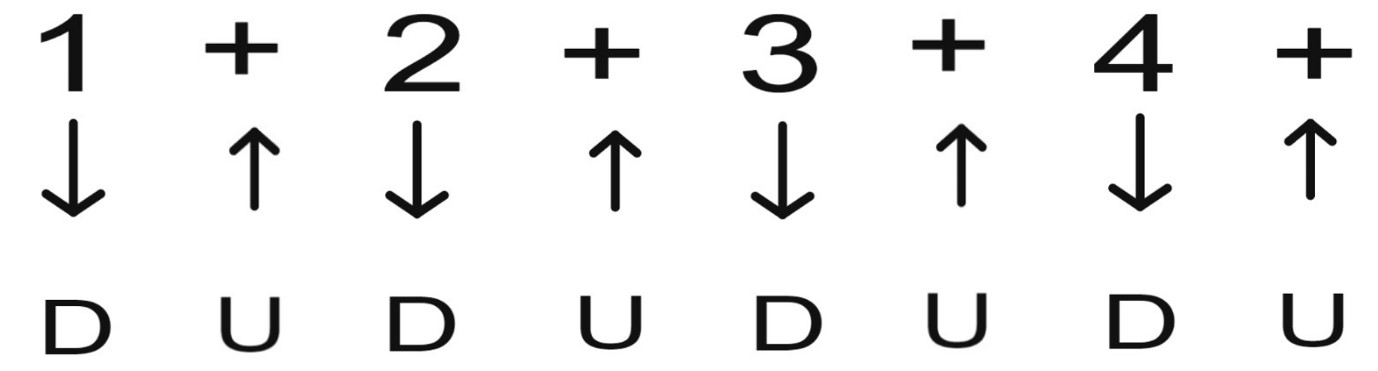
As you strum, you need to maintain concentration. The lack of harmony, chords, chord changes may fool you into thinking and believing that this is tedious and without musical value. Hold your focus though and learn to allow yourself to enjoy this simple task. Train your brain and hands to work together.
Count out loud: 1 and 2 and 3 and 4 and …
When that is coming naturally make a switch.
Count out loud: Down Up Down Up Down Up Down Up …
When that is coming naturally, make a counting switch as you go, count the numbered beats with ands several times, switch to Downs / Ups for several repeats then numbers again etc etc.
Make sure you always know where beat 1 is. It is vital. Beat 1 grounds you in the structure and attaches you to what is happening.
Say what you play and play what you say.
You will build and strengthen synapse connections between your brain and hands that are a foundation for rhythm and rhythmic playing for your life.
Once the all 8ths strumming has served a purpose, move on to patterns of 8ths where some of the Up strums are removed. Start, say, with removing three Ups, giving four permutations to follow and go through a process similar to above.


3 Likes
@Richard_close2u
This definitely helps. Thank you!
1 Like