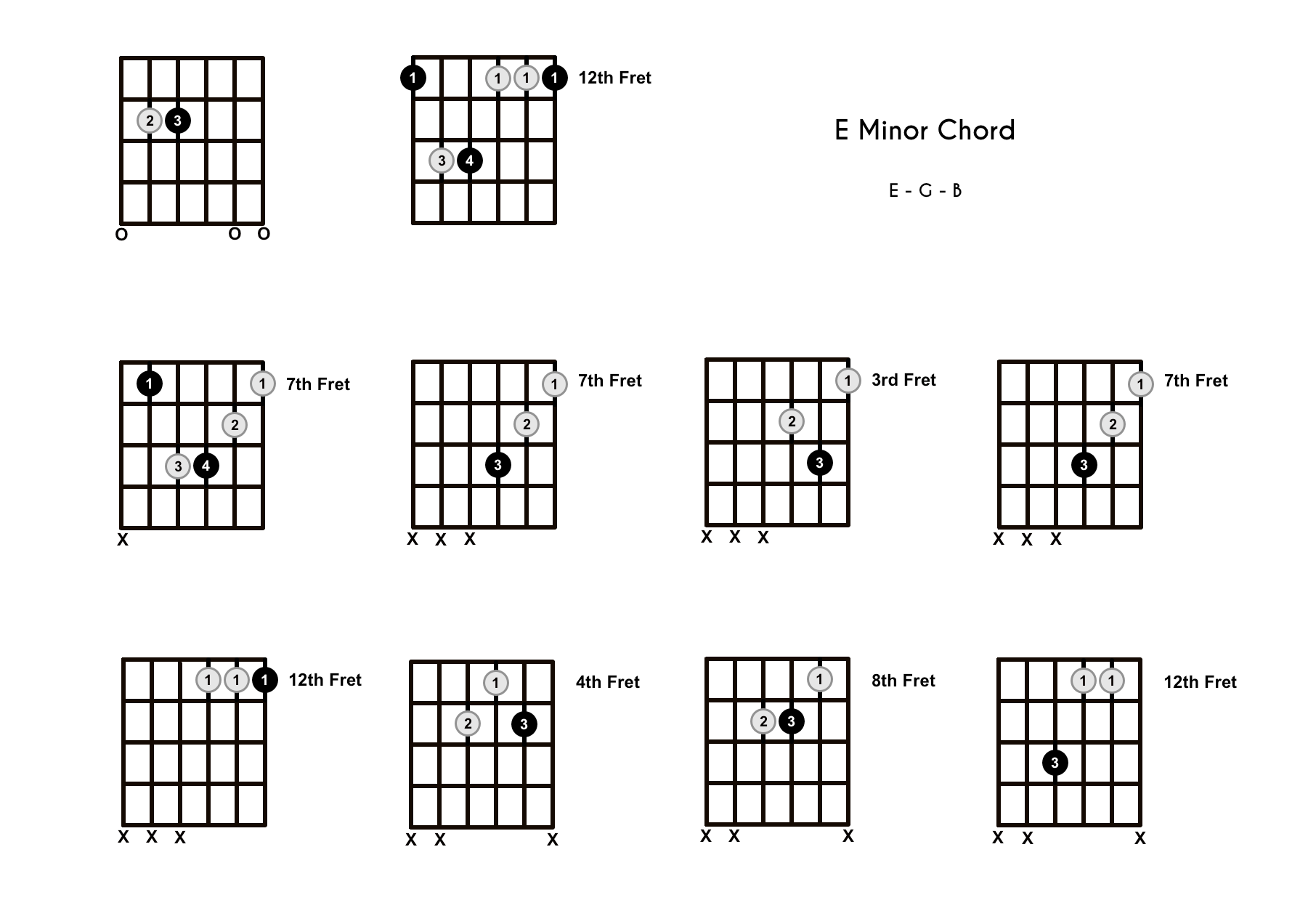
The song I want to try this on is ‘The times, they are a-changing’, which originally has a capo at the first fret already. The chord shapes are G, e minor, C, D, and a minor, as well as a few variations on D, which I’m just ignoring for the moment. I peaked at Justin’s cheat sheet, and it looks like all the major chords are around at the 7th fret. My questions:
The original has a capo at 1st fret, so I’ll be putting my capo at 8th fret, and use the chord shapes from the cheat sheet in 7th fret for the major chords, right? So G shape=C shape, C shape=F shape, D shape=G shape, right?
Does anyone have an idea what I could do for the Cadd9, B/D, and A/D? My ‘solution’ at the moment is simply not playing anything for those bars, which does not feel very cool, I have to say.
The easiest way to figure out where to put the capo goes is to figure out what the original chord progression is.
You’re working with G, Em, C, D and Am. G is the 1, Em is the 6, C is the 4, D is the 5 and Am is the 2.
If you want to play using a chord progresson in C you need to know 2 things.
where on the capo need to be for a C chord to be a G chord?
what is a 1, 6, 4, 5, 2 chord progression in C.
Then all you do is add one more fret to where you would place the capo because you’re already capo 1 for the original. So you’re looking for the G# note on the A string to play the C chord shape place capo accordingly and use the chords in the key of C.
If you want to try using lets say the chord in the key of D use the same formula, figure ou what the 1, 6, 4, 5, 2 in the key of D and figure out where the D chord makes a G# on the fret board place capo accordingly.
I don’t know if I understand you correctly. It looks to me like you’re giving me the tools to change the key of the song from G# to C#, which is not what I want to do. I want to play the same chords in the same key, just higher on the fretboard.
Ah no, wait. I think I’m getting it. For the minor chords I need to find the shape of the corresponding chords in C, and just play that. So that’s an Am shape for 6, and a Dm shape for 2, right? And although we are changing the shapes as if we are changing the key, we aren’t really changing the key because of the capo. I think I might just have understood something fundamental about guitar^^ Thank you.
Edit: Sounds so much better, and since it’s G to C, it’s all easy chord shapes, too.
You got it, you’re not changing key just chord shape because the capo keeps it in the same key.
Using what you’ve just learnt try using the chords in a differnt key like A or D to see if you come up with something better. All you need to remember is the original is already capo 1 which makes it G# note G.
Hm, I think I like the D# at 6th fret a bit more. It only has Bm as a barre chord shape, and that is easier than the F barre in C#. A# is out cause I know how to play F#m, but it’s more of a hassle for me, so I don’t like doing it. Also, 11th fret is pretty small for my fingers, and because my guitar is pretty shitty, it’s quite out of tune this high up, and the strings are quite a ways away from the neck.
Huh, this is fun. Let’s see what other songs I can do this to^^