ooops I think it might be the verse of the winding on the three thinnest strings.
It’s the second time I try to change the strings without Justin’s tutorial…the first time I broke the E bass string…on the third attempt maybe I’ll do fine
Its fine, you wont break anything. The biggest issue you may have is trouble tuning, as the break angle of the strings over the nut is greater than designed. And the G and B strings may or may not be touching the tuning machines for the next string down, I cannot tell from the picture. The other thing that may happen is that your fingers get used to tuning those strings backwards. It is less than ideal, but not earth shattering.
If it was me, I’d leave it the way it is and correct it next time you change strings.
Yep, the 1, 2, and 3 are strung backwards. It’s going to make tuning awkward. The 2 and 3 string are in contact with the post below their own, which I’d imagine is going to act like a capo at that point. To tune them to the correct pitch you’re going to have to make them have much less tension, effecting the neck. I’d re-do those. It won’t take long.
tuning them will be annoying, maybe. I would turn the tuner a bit and then bend a note to put it in place and overcome the friction of the tuning post it is sitting on then see if you need more or less.
Good chance you will break the string at the point it bends coming out of the tuner hole. I have tried to fix a botched re-string (not enough turns usually) and have had the string break on me. I have been ok with using the end and making a bit of a hook to wrap it around itself when it wraps half way around the tuner post and then I can usually live with the not enough turns problem. I cant see if you have too many turns. If you do, then you are likely ok to fix it simply by loosening and re-tightening the correct direction.
Leaving it this way may not be a good idea. Most of the luthier resources i have seen about this very thing say, there is an increased chance of binding the e/b/g strings due to the increased lateral force on the nut and causing odd erosion of the nut slot.
The worse thing is you increase the chance of breaking your nut. I read some accounts on nuts moving out of place with vintage guitars that the glue joints drieds and failed after many years.
Just fix it, 5 minute spinaroonie.
You will save the guitar universe from implosion and humanity will be better for it.
I couldn’t understand if Jason was just joking or speaking for real so I took courage and, after figuring well out in my mind how to do the winding, I tried. Michael
thank you for writing about your experience…it made me being super careful!
I made sure the string coming out from the hole to be secured between two turns around so I espect to find the strings still there tomorrow
Thanks again…next time I should be able to do correctly straight away, I think I’ve memorised the verse of the winding in the two sides of the the headstock
So you dont do it again.
A simple rule. The tuner pegs ALWAYS turns in the same direction, away from the nut on top, toward the nut in the bottom, as you folliw the pegs around the ‘semi-circle’ of the head stock.
I just finished changing the strings on my acoustic (it was well past due.) Polished the frets, cleaned the whole guitar, oiled the fretboard. While I was at it, I replaced the plastic bridge pins with ebony. I don’t know if that will make any difference, but it seems classier!
Doing guitar maintenance is easy to put off, but getting it done is so satisfying.
You can bet on this! A bit annoying that I always need to learn from mistakes and rarely get to learn to do things correctly straight away
I find the verbal instruction a bit confusing in this case, whatever is the language used. If you look at a “correctly strung” headstock you immediately should understand the direction of the first turn of the string, and the verse of the pegs winder comes as a consequence.
And for those like me it takes to look at a “wrongly strung” headstock to get aware of that …but once the is on it will be on forever
I do agree, I much enjoy doing it! And the greater satisfaction for me is when I hear the fresh sound of the new strings…and my ears go like “Oooh…finally!”
Interesting. I stopped and double checked my guitars. All the strings were tightened with a counterclockwise motion. That’s odd.
The vast majority of the time you “tighten” things you do it with a clockwise rotation. The standard convention for fasteners is the right hand thread which means most things are tightened with a clockwise rotation. Nuts, bolts, screws, light globes, taps, bottlecaps; all these things are tightened with a clockwise rotation. You’ve performed this action countless times throughout your life.
The only things I have ever tightened with a counterclockwise rotation are:
1.the left side bicycle pedal (otherwise it unwinds),
2. attaching a regulator to a bottle of flammable gas (Acetylene, propane). If you have a gas bottle for a BBQ you will notice that the regulator has a left hand thread.
and now
3. the strings on all of my guitars!
I have no idea why guitar machine heads go against the convention for fastening. So you placed your string in the machine head and did what you’ve done all throughout your life, tightened it with a clockwise motion. Then you stopped, scratched your head and wondered how the hell you screwed up something so simple.
Maybe I’m wrong though. Is everyone else experiencing the same thing?
Never thought of it in the same terms as screw threads or bottle caps. My 1st guitar was/is a Strat type, and I thought of it as turning the tuners in the direction of pulling the string tighter; i.e., toward the headstock.
Of course, that doesn’t work with the 1, 2, and 3 strings on my other two guitars (Taylor acoustic and PRS electric) that I’ve gotten since, but I just adjusted to it being in the opposite direction for those strings.
The tuning knobs on all my instruments tighten the strings with an anticlockwise turn, including both 6-in-a-line and 3-on-a-side arrangements.
Poke the string through the hole
loop the wire over the post
—towards the high E with a 6-in-a-line configuration
—towards the centre with a 3-on-a-side configuration
turn the knobs anticlockwise to tighten.
Justin uploaded an acoustic guitar string change video only 3 months ago. All the knobs are turned anticlockwise to tighten. This is the same technique I learnt it from an intheblues video. Even Justin has a hiccup at 16:05.
Anticlockwise to tighten is unusual. If you’ve never used a flammable gas cylinder or attached bicycle pedals you may never have done it.
I did exactly the same sort of thing a couple of days ago - I don’t think I should have been touching the guitar!
First off I started to put the Low E where the High E should be, realised before I had actually started winding.
Then I started winding the wrong way
Then I managed to confuse myself with the ‘one over, one under’ winding.
I think some of it was that I had just seen a video on Youtube about a slightly different way of doing things (same wind, but starting point and end point were different)
I oiled my fretboard too (nice lemony smell it was too, I found it extremely satisfying…).
Subsequently my luthier (at a high end place, mostly old instruments, as in uptown of 200 years old) said,
Please do not use oil on your fretboard, or anywhere on your guitar. If, for some reason, we must use glue for repairs, oiled wood doesn’t bond well with glue and we have to remove the oil before the glue can bond.
The luthier essentially said, clean it – but do not oil it.
This advice certainly aligns with my (limited) experiences doing fine carpentry…
(He also, diplomatically, mentioned playing with clean hands…)
Has anyone else heard this wisdom about not using oil on the fretboard?
There are all sorts of conflicting messages about oiling the fretboard in this here JG Community (and even more so elsewhere) eg


 ooops
ooops  I think it might be the verse of the winding on the three thinnest strings.

 No damage though.

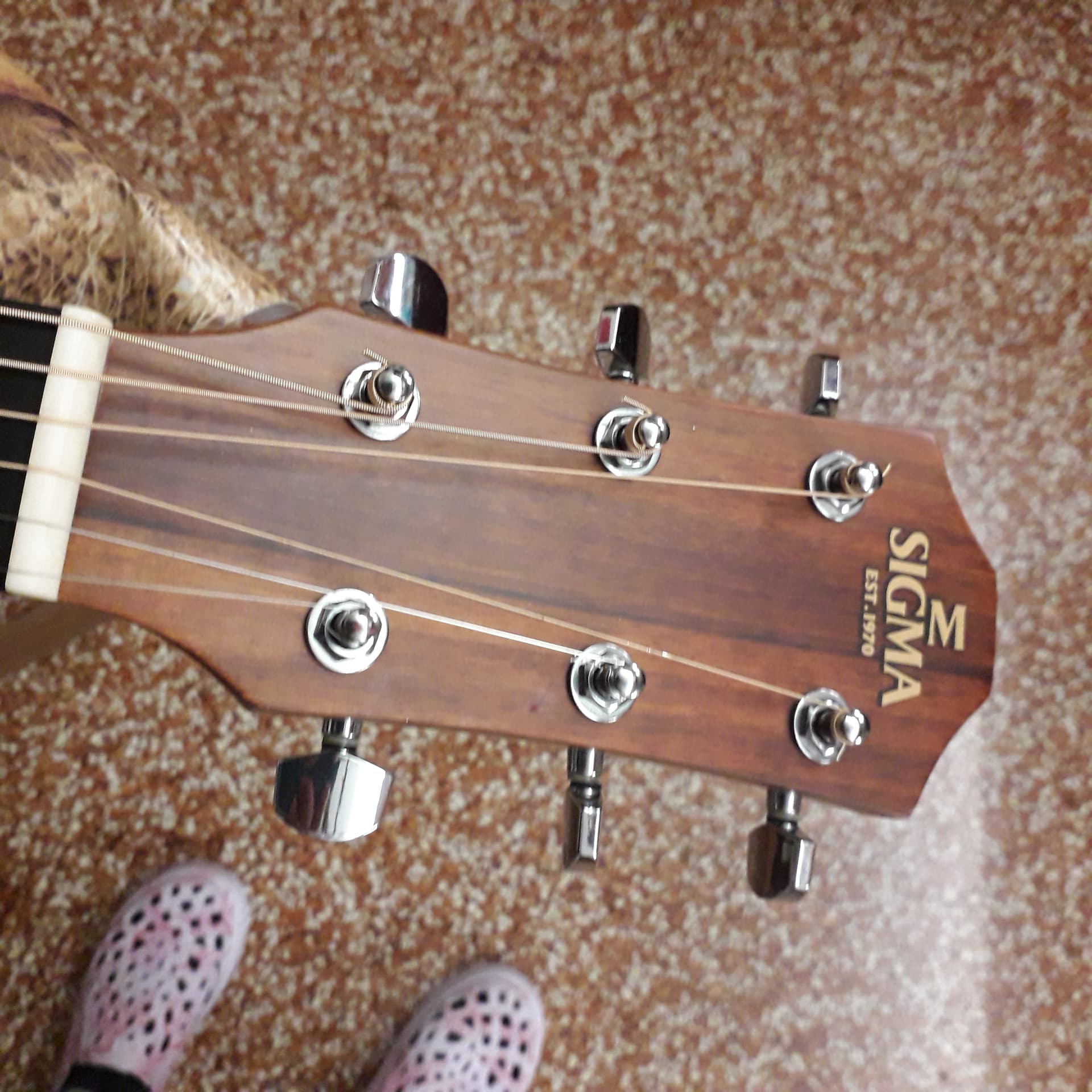
 I fixed it! And it took only 15 minutes in all


 …but once the
  is on it will be on forever